






IMMENSE Project
Innovation in health and Materials researches through interdisciplinary Magnetic resonance: from Electrons to Nuclei, from Spectroscopy to imaging Experiments
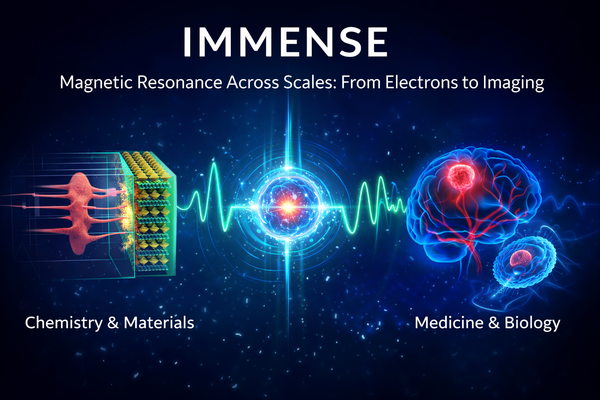
Mapping the spatial distribution of chemical species is essential for addressing in disciplines as diverse as medicine and materials science. For example, these chemical imaging tools will be critical for the early diagnosis of neurological and psychiatric disorders, as well as for understanding the aging of energy devices, including batteries and solar cells. However, existing chemical imaging tools suffer from limitations, such as low penetration depth, harmful effects of ionizing radiation or lack of sensitivity and resolution. To overcome these problems, the IMMENSE project aims to develop novel magnetic resonance (MR)-based chemical imaging approaches that can be used in both the fields of medicine, biology, chemistry and materials science. More specifically, we will develop innovative contrast agents to visualize protein aggregation caused by Alzheimer’s disease in the brain using magnetic resonance imaging (MRI) at high magnetic fields. We will explore how artificial intelligence (AI) can be leveraged to improve the resolution of MR spectra of a wide range of samples (from cerebral metabolites to materials) at low magnetic fields using high-field data. We will develop novel approaches to diagnose metabolic disorders in the brain using high-field MR. Novel MR-based chemical imaging tools will also be introduced to study defect formation in energy devices, including commercial batteries and solar cells. These research developments will be linked to several education and training activities to ensure the long-term impact of this project. This project will benefit from the excellence of the different partners in the consortium with complementary expertise in medicine, biology, chemistry, materials science and AI, as well as the different aspects of MR. A major asset will also be the presence in our laboratories of ultra-high-field MR instruments, including a 1.2 GHz NMR magnet with a field of 28 T, a 263 GHz EPR spectrometer with a field of 9 T and a 7 T whole-body MRI scanner. This interdisciplinary project will have a major scientific impact on health and energy, thus enhancing the international visibility of the partners and providing opportunities for partnerships with industry.
Project management

The project in figures
Budget
Project duration
Research laboratories
Researchers, Teachers, Engineers
Big magnetic resonance instruments
Fellows (PhD & junior researchers)